Hobson, the story goes, operated a large stable with horses available for let. One could pay to use a horse from his stable, but you were not free to select any horse you liked. You could have the horse currently up for rotation, or you could shove off. This probably worked quite well for Hobson, ensuring that his most popular horses did not become overworked. At any rate, he managed some small measure of immortality; a "Hobson's Choice" is any choice where the only options are accepting all the terms, or none at all. There's nothing inherently bad about these types of choices. But what if Hobson's stable was the only one in town? And if horses were so heavily used that access to one was no longer a luxury? And what if his rotation wasn't a fair FIFO system, but something more sinister, like giving the worst horses to those least able to complain?
Hobson, the medieval stable master, would have found himself right at home on the internet. Whether you realize it or not, every trip through cyberspace is riddled with Hobson's choices. It starts at the plug in the wall; if you want anything coming down your wires you must agree to the conditions put forward by one of a handful or fewer ISPs available to you. Then almost every website you visit has a Terms of Service (I've touched on these before). And for every service you use, even the most basic like email, you've checked off your assent to a massive User Agreement. There's almost nowhere to hang your hat that isn't fenced in with thousands of words of legalese defining exactly what you are allowed to do. You don't often think about the presence of all this contractual weight, but it's there, every time you bring up a browser.
What's really appalling about all these terms is how much they take away and how little they offer. Most ISPs, if they so chose, could give you no connection at all, for as long as they pleased, and continue to bill you for it. The provider's side of these agreements is legal ass-covering, allowing them to give as little service as they please and still be within the terms of the contract, protected from litigation.
Here's Comcast stipulating that they can install software on any device you connect to their service (i.e. your computer), and that they are not responsible for any damage they cause by doing this (emphasis mine):
Customer Equipment consists of software or services that you elect to use in connection with the Services or Comcast Equipment (the “Customer Equipment”). You agree to allow us and our agents the rights to insert cable cards and other hardware in the Customer Equipment, send software and/or “downloads” to the Customer Equipment and install, configure, maintain, inspect and upgrade the Customer Equipment and Comcast Equipment.Comcast User Agreement, Section 5.b
Comcast has no responsibility for the operation or support, maintenance, or repair of any Customer Equipment including, but not limited to, Customer Equipment to which Comcast or a third party has sent software or “downloads.”Comcast User Agreement, Section 6.b.1
In case that's not enough, here's Comcast indemnifying themselves against anything short of gross negligence, and claiming that even in that case you cannot be entitled to more than $500 (emphasis mine):
CUSTOMER EQUIPMENT MAY BE DAMAGED OR SUFFER SERVICE OUTAGES AS A RESULT OF THE INSTALLATION, SELF-INSTALLATION, USE, INSPECTION, MAINTENANCE, UPDATING, REPAIR, AND REMOVAL OF COMCAST EQUIPMENT, CUSTOMER EQUIPMENT AND/OR THE SERVICES. EXCEPT FOR GROSS NEGLIGENCE OR WILLFUL MISCONDUCT, NEITHER COMCAST NOR ANY OF ITS AFFILIATES, SUPPLIERS, EMPLOYEES, AGENTS, OR CONTRACTORS SHALL HAVE ANY LIABILITY WHATSOEVER FOR ANY DAMAGE, LOSS, OR DESTRUCTION TO THE CUSTOMER EQUIPMENT. IN THE EVENT OF GROSS NEGLIGENCE OR WILLFUL MISCONDUCT BY COMCAST, SUPPLIERS, EMPLOYEES, AGENTS, OR CONTRACTORS, WE SHALL PAY AT OUR SOLE DISCRETION FOR THE REPAIR OR REPLACEMENT OF THE DAMAGED CUSTOMER EQUIPMENT UP TO A MAXIMUM OF $500. THIS SHALL BE YOUR SOLE AND EXCLUSIVE REMEDY RELATING TO SUCH ACTIVITY.Comcast User Agreement, Section 10
Meanwhile, your side of the terms may contain any number of constrictions on what you are allowed to do. Many create licensing terms that cede everything you create to the control of the company, to use however they please. Here's Facebook:
For content that is covered by intellectual property rights, like photos and videos ("IP content")... you grant us a non-exclusive, transferable, sub-licensable, royalty-free, worldwide license to use any IP content that you post on or in connection with Facebook ("IP License").Facebook ToS, Section 1
Notice that they may license your content out to others if they wish. To Facebook's credit, they no longer claim the license to be "perpetual" and "irrevocable". They briefly added those terms in 2009, and backed off after facing considerable backlash.
Many of these documents state that the terms may change at any time, with no warning, and that your continued use of the service will be bound by these new terms. Here's Comcast again (emphasis mine):
Subject to applicable law, we have the right to change our Services, Comcast Equipment and rates or charges, at any time with or without notice. We also may rearrange, delete, add to, or otherwise change programming or features or offerings contained in the Services, including, but not limited to, content, functionality, hours of availability, customer equipment requirements, speed, and upstream and downstream rate limitations. If we do give you notice, it may be provided on your monthly bill, as a bill insert, e-mail, in a newspaper or other communication permitted under applicable law. If you find a change in the Service(s) unacceptable, you have the right to cancel your Service(s). However, if you continue to receive Service(s) after the change, this will constitute your acceptance of the change.Comcast User Agreement, Section 4
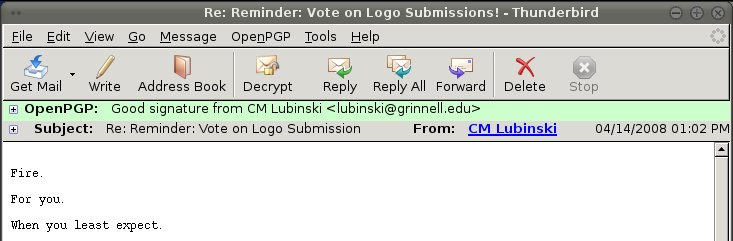
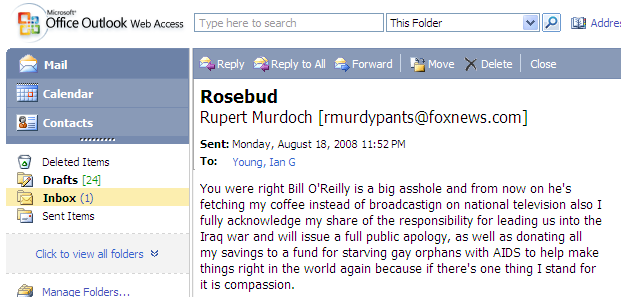
Then, of course, are the terms that are simply absurd. When Grinnell College rolled out their new alumni network, John Stone noticed that The Loggia Terms and Conditions disallowed, among other things:
Reproducing and storing data in a retrieval system (electronic or mechanical)
From a technical standpoint, one cannot view a webpage without storing and reproducing data locally, making it impossible to actually use the service and still be in compliance with this rule.
To do even the most mundane tasks online, you are forced to relinquish a great number of rights, but in return you receive absolutely nothing except the optimistic hope that the company will provide something to you. You are signing a contract for empty air, and if you're lucky the company will choose to bestow upon you some favors. If these are legally viable is a bit of an open question. Most notably, these agreements could be considered contracts of adhesion and may be unenforceable due to the doctrine of unconscionability. Vagaries of the law aside, it should be apparent that this type of agreement, wielded without oversight, is morally wrong.
At first blush, the TSA situation seems far removed from that inflicted on us by private companies. After all, the government is the one entity that can compel us to obey certain rules, whether we choose them or not. You don't get to opt out of the legal system, even if you want none of the benefits.
But let's examine the TSA's role. Flying is, in the end, a purely voluntary activity. You cannot be compelled to endure an unconstitutional body scan or enhanced patdown if you simply choose not to travel by airplane. Another Hobson's choice. Like many of the others, this choice is a coercive force for many of us. Some people depend on air travel to perform their jobs. Others have no other way to see relatives or friends in far away places. While it's admittedly a middle-class pursuit, air travel is nearly a necessity for many of us who can afford it.
Much of TSA's power, as it turns out, stems from this choice. There has been some bluster during the recent opt-outs about levying a civil fine for leaving the airport after the screening process has begun, but it's unlikely those threats will ever be made good on. And that's a civil fine, the only kind TSA has the authority to level. This fascinating account is written by a man who refused to submit to the new policies as a condition of being allowed through customs. The best part is when actual police offers get involved, officers who have been trained on constitutional rights.
I clarify, “Well, like I said, I’ll do whatever you say is mandatory. If you tell me that you have to touch my balls—“
“—I said no such thing. You’re putting words in my mouth.”
“OK. I apologize. If you say that a pat-down is mandatory, and that as a condition of that pat-down, I may have my genitals brushed against by your hand, even though you don’t want to, I will do that. But only if you say it is mandatory.”
“I’m not going to say that.”
The TSA has no real authority. Their power stems only from the fact that they control access to a service that is nearly ubiquitous and seriously disadvantages those who refuse the terms. So they can present a Hobson's choice, safe in the knowledge that almost everyone will submit. Sound familiar? TSA is nothing more than another abusive monopoly.
Let's take one final step back. I said earlier that a government is the one entity that can compel you to obey certain rules without any agreement on your part. Enter Hobbes (a very different and much more famous man than our titular Hobson). His most enduring idea is that government is a social contract:
I authorise and give up my right of governing myself to this man, or to this assembly of men, on this condition; that thou give up, thy right to him, and authorise all his actions in like manner.Thomas Hobbes, Leviathan
We give up some of our rights, like the right to beat other people over the head with big sticks, for the goal of living peacefully and prosperously, safe from the constant danger of being beaten over the head with a big stick. Being governed is a voluntary act (let's ignore Hobbes' autocratic leanings for the sake of simplicity), undertaken because it's to our long-term benefit.
Of course, few of us actively take part in any kind of contractual ceremony agreeing to these terms. We fall under the government's jurisdiction by the circumstance of being born where we were born, living where we live. In fact, land ownership is the source of a government's authority. You may decide to "opt out" of the laws of a country, but you should not remain on that country's land and expect to escape punishment. Conversely, if you leave a country's land, you are no longer subject to their laws. Extradition feels like an exception to this rule, but it's merely an agreement between countries. Extradition does not work when the host country refuses to play along.
So! The government controls access to a desirable resource (land). This allows them to require adherence to a stringent set of rules from anyone wishing to gain access. Even if the rules seem unfair, a choice between that or nothing at all leads almost everyone to obey. Hopefully by this point you're drawing your own parallels. That's right, I see governments as nothing more or less than the biggest corporation around, one whose services we all consume. We pay a subscription fee. We reap tangible benefits. All the elements of a contractual agreement are there.
And yet, there's one thing the government offers us that no consumer relationships do: the ability to negotiate. The system is horribly inefficient, riddled with bureaucracy, and easily derailed. But in the end, we the people do get a say in the rules that are applied to us. More importantly, we see the idea of a government that answers to the people as obvious and absolutely necessary. So why don't we apply this same expectation to corporations? Why do we insist that corporations are accountable only to their shareholders, instead of to the collective public whose lives they so deeply affect?
Looking to the future, I don't think the government will be the one to relieve us of our freedoms. Sure, there will be battles. But the Bill of Rights has survived two centuries more or less intact, and I expect it will keep on truckin'. We won't lose our rights at gunpoint. We'll lose them in bits and pieces, so slowly as to be nearly imperceptible. We'll sign them away one after another in the name of new services or free beer or just following the crowd. Technically, they won't be gone, but a right that we are not free to exercise in the most frequented arenas of public discourse isn't much of a right at all.
Epilogue
My slow blogging habits caught up to me once again. I hadn't even started putting this post into words before the furor over the TSA scanners had been totally eclipsed by the Wikileaks controversy. It's a complex affair, and I could write an incredible volume on the details of the various events surrounding Cablegate, but I think I'll leave that to others, and draw two small connections instead.
The intentions of the government towards Wikileaks, as far as we can divine them, are rather serious, and in some ways conflict with what I just said. The organization, of which our government was at least tolerant — perhaps even fond — when it was dishing out leaks from third worlds and no particular friends of ours, has become a thorn in the side of some very powerful interests. The Obama administration seems intent on finding a way to declare Wikileaks' actions illegal, though there seems to be no law that fits. There's no attack on Wikileaks as a whole that isn't a dangerous attack on free speech, and it's being perpetuated by our own government. If this comes to pass, it will be one of the battles I predicted, perhaps a very important one.
In other ways, however, the assault on Wikileaks has made plain for the first time how much power corporations wield over our speech. The threatened legal action has not materialized, and may never come to pass if those in power can't find a good story to tell about why silencing Wikileaks is no cause for concern. In the meantime, however, direct and damaging action has been flowing in from the private sector. In the space of a few days, Wikileaks experienced cutoffs by hosting services, domain name services, and at least four financial services. All of these cited vague "terms of service violations", but there's little reason to doubt that these shutdowns were incited and choreographed by political interests. As Richard Stallman opines, "It is as if we all lived in rented rooms and landlords could evict anyone at a moment's notice."
It remains to be seen whether the government's feud will be derailed by legal protections we have put in place, but there's reason to be optimistic. In the private sector, though, it's been made clear just how great of a blow can be dealt to our freedoms when they become inconvenient to the powerful. We shouldn't need a "use case" for retaining our basic freedoms. For me, idealist notions about the value of freedom for freedom's sake are enough to compel resistance to these Hobson's choices. But if you're of a more pragmatic mindset, I can't think of a better spectre than government and corporations cooperating to stifle political dissent.




 Posts
Posts

